
Elephant List

Description
Elephant List is a structured communication game designed to surface and address the unspoken issues that often hold teams back. The name comes from the expression "elephant in the room" — those obvious problems everyone notices but nobody talks about.This activity works exceptionally well for remote teams reconnecting in person, long-standing teams that have fallen into communication ruts, or any group where honest dialogue has stagnated.
By creating a safe, anonymous framework for raising difficult topics, Elephant List breaks through the politeness barrier that often prevents teams from tackling real issues.The game uses a simple but powerful framework: Control, Influence, Accept (C.I.A.). Participants categorize each "elephant" based on what the team can actually do about it:
Control — Issues the team can directly resolve through their own actions-
Influence — Issues the team can affect but not fully control (requiring stakeholder buy-in, leadership decisions, etc.)-
Accept — Issues outside the team's power that must be acknowledged and adapted toThis categorization prevents the activity from becoming a complaint session. Instead, it channels energy toward actionable solutions while building acceptance for unchangeable realities.Elephant List creates psychological safety through anonymity in the writing phase, then builds trust through facilitated group discussion.
Goal
The primary goal of Elephant List is to create a safe space for teams to surface and address unspoken workplace issues that may be hindering collaboration, morale, or performance.
Specific objectives include:
1. Break Communication Barriers
Encourage team members to voice concerns they might otherwise keep to themselves. The anonymous writing phase removes fear of judgment or retaliation, allowing honest issues to surface.
2. Build Psychological Safety
Demonstrate that difficult topics can be discussed constructively without negative consequences. This builds trust for future open communication.
3. Develop Problem-Solving Skills
Train teams to categorize challenges using the Control, Influence, Accept framework — a practical tool they can apply to any workplace challenge beyond this activity.
4. Create Actionable Outcomes
Move beyond venting to concrete next steps. "Control" elephants get assigned owners and deadlines. "Influence" elephants generate advocacy strategies. "Accept" elephants receive acknowledgment and coping approaches.
5. Strengthen Team Cohesion
Shared vulnerability and collaborative problem-solving build stronger interpersonal bonds. Teams that tackle difficult conversations together develop deeper trust.
6. Prevent Issue Escalation
Surface small frustrations before they become major conflicts. Regular use of Elephant List (quarterly or at each offsite) creates a healthy release valve for workplace tensions.
Materials
Required Materials:
- Sticky notes or index cards (3-5 per participant)
- Pens or markers for each participant
- Three containers, envelopes, or designated wall sections labeled:
- "Control"
- "Influence"
- "Accept"
- Whiteboard, flip chart, or large paper for group discussion
- Timer (phone works fine)
Optional Materials:
- Printed C.I.A. Framework explanation cards
- Dot stickers for voting/prioritization (if time allows)
- Digital collaboration tool (Miro, Mural, or Slido) for hybrid/remote adaptation
- Background music to play during silent writing phase
Room Setup:
- Arrange seating in a circle or U-shape to facilitate discussion
- Ensure writing surfaces for participants (tables, clipboards, or hard-backed notebooks)
- Create visible C.I.A. collection areas on a wall or table
- Have flip chart ready to capture action items during discussion
For Remote/Hybrid Teams:
- Use a digital whiteboard (Miro or Mural) with three columns
- Anonymous submission via Slido, Mentimeter, or Google Form
- Breakout rooms for small group discussions before full-team debrief
Instructions
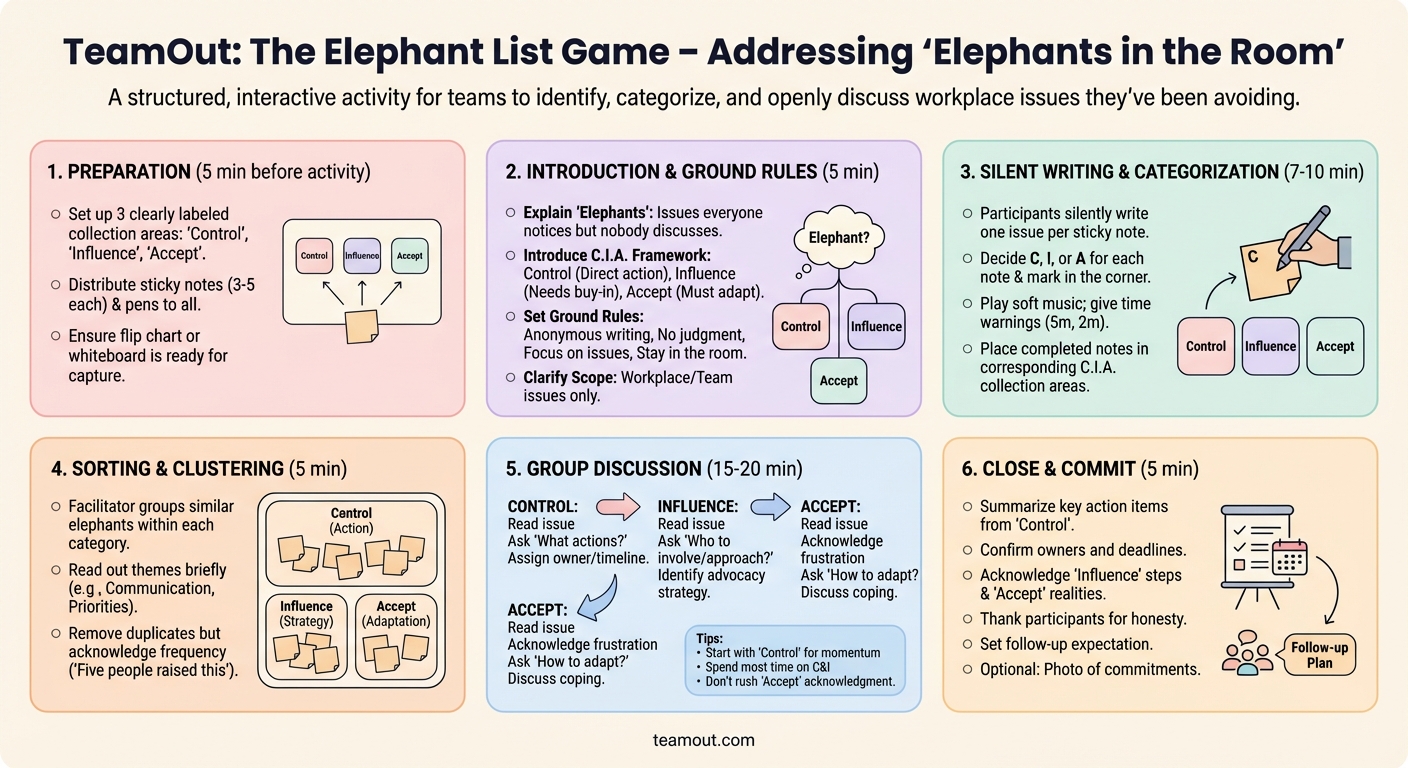
PREPARATION (5 minutes before activity)
1. Set up three clearly labeled collection areas: "Control," "Influence," and "Accept"
2. Distribute sticky notes (3-5 each) and pens to all participants
3. Ensure flip chart or whiteboard is ready for capturing discussion points
4. Brief any co-facilitators on their role
PHASE 1: INTRODUCTION (5 minutes)
1. Explain the concept of "elephants in the room" — issues everyone notices but nobody discusses
2. Introduce the C.I.A. Framework:
- Control: "We can fix this ourselves through direct action"
- Influence: "We can affect this but need others' buy-in"
- Accept: "This is outside our control; we must adapt"
3. Set ground rules:
- Anonymous writing — no names on sticky notes
- No judgment during sharing
- Focus on issues, not individuals
- What's shared in the room stays in the room
4. Clarify scope: workplace/team issues only (not personal grievances against specific people)
PHASE 2: SILENT WRITING (7-10 minutes)
1. Ask participants to silently write down "elephants" — one issue per sticky note
2. For each elephant, they should decide: Is this something we can Control, Influence, or Accept?
3. Participants write "C," "I," or "A" in the corner of each note
4. Play soft background music to reduce awkward silence
5. Give time warnings at 5 minutes and 2 minutes remaining
6. Participants place completed notes in the corresponding C.I.A. collection area
PHASE 3: SORTING & CLUSTERING (5 minutes)
1. Facilitator (or volunteer) groups similar elephants together within each category
2. Read out themes briefly: "I'm seeing several notes about communication between teams" or "Multiple people mentioned unclear project priorities"
3. Remove any duplicates but acknowledge frequency: "Five people raised this same issue"
**PHASE 4: GROUP DISCUSSION (15-20 minutes)**
For "Control" elephants:
- Read the issue aloud
- Ask: "What specific actions can we take to address this?"
- Assign an owner and timeline for follow-up
- Capture commitments on flip chart
For "Influence" elephants:
- Read the issue aloud
- Ask: "Who do we need to involve? What's our approach?"
- Identify advocacy strategies or escalation paths
- Note who will lead the influence effort
For "Accept" elephants:
- Read the issue aloud
- Acknowledge the frustration openly: "This is hard, and it's real"
- Ask: "How can we adapt or cope with this reality?"
- Discuss mindset shifts or workarounds
- Place in "Accept" pile with group acknowledgment
Facilitation tips:
- Start with "Control" items to build momentum with actionable wins
- Spend most time on "Control" and "Influence" categories
- Don't rush "Accept" — acknowledgment is therapeutic
- If discussion gets heated, redirect: "Let's focus on what we can do"
PHASE 5: CLOSE & COMMIT (5 minutes)
1. Summarize key action items from "Control" category
2. Confirm owners and deadlines are captured
3. Acknowledge "Influence" items and next steps
4. Validate "Accept" items: "These are real challenges we're carrying together"
5. Thank participants for their honesty and vulnerability
6. Set expectation for follow-up: "We'll revisit these action items in [timeframe]"
7. Optional: Take photo of flip chart commitments to share with team afterward
Tips to implement the activity the right way
**For Facilitators:**
**Before the Activity:**
- Do a "temperature check" on your team — if there's active conflict or someone is in crisis, this may not be the right time
- Have a private conversation with leadership about potential sensitive topics that might surface
- Prepare yourself for uncomfortable revelations — your calm demeanor sets the tone
- Consider running this after a meal or energizing activity when people are relaxed
**During Silent Writing:**
- Walk around the room to signal you're available but not monitoring what people write
- If someone looks stuck, quietly suggest prompts: "What frustrates you most about our current process?" or "What do you wish the team talked about more?"
- Don't rush this phase — silence is productive
**During Discussion:**
- Read elephants exactly as written — don't paraphrase or soften language
- If an elephant targets a specific person (shouldn't happen with good framing, but it might), redirect: "Let's focus on the behavior or situation rather than individuals"
- Validate emotions before problem-solving: "It makes sense that this is frustrating"
- Watch for body language — someone looking down may have written the note being discussed
- Don't force resolution on everything — some issues just need acknowledgment
**Common Pitfalls to Avoid:**
- Letting one person dominate discussion — actively invite quieter voices
- Spending too long on "Accept" items and creating a negative spiral
- Making promises you can't keep — be honest about limitations
- Skipping the follow-up — this destroys trust for future activities
**After the Activity:**
- Send summary email within 24 hours with action items and owners
- Schedule check-in on "Control" items within 2 weeks
- Consider making Elephant List a quarterly ritual
---
**Variations:**
**For Remote Teams:**
Use Miro or Mural with anonymous sticky notes. Have participants submit via private Slido before revealing all at once. Use breakout rooms for small group discussion before full-team debrief.
**For Very Large Groups (50+):**
Divide into smaller groups of 8-12, each with a facilitator. Groups share top 2-3 elephants with full room. Combine duplicate themes across groups.
**For Shorter Time (20 minutes):**
Limit to 2 sticky notes per person. Focus discussion only on "Control" items. Table "Influence" and "Accept" for follow-up session.
**For Teams New to Vulnerability:**
Start with a "low stakes" warm-up round: "What's one small thing that annoys you about our office/tools/process?" This builds comfort before deeper issues.
**For Leadership Teams:**
Add a fourth category: "Delegate" — issues that should be pushed to another team or individual to own.

