
What If

Description
What If is a simple yet powerful question game that transforms ordinary team gatherings into memorable bonding experiences. The premise is straightforward: participants take turns posing hypothetical "What if..." scenarios and sharing their creative responses.
Unlike standard icebreaker questions, What If scenarios tap into imagination and playfulness. Questions like "What if you woke up tomorrow as CEO of any company?" or "What if you could only communicate through song lyrics for a week?" invite responses that reveal personality, values, humor, and creative thinking — far more than asking someone's favorite color ever could.
The game's magic lies in its flexibility. You can keep it light with absurd scenarios ("What if pizza was declared a vegetable?") or go deeper with thought-provoking prompts ("What if you could solve one world problem overnight?"). This adaptability makes it perfect for any team context — from quick meeting warm-ups to extended retreat activities.
What If works exceptionally well because it levels the playing field. There are no right answers, no winners or losers, and no special knowledge required. The shy intern and the senior executive are equally equipped to imagine what they'd do if they suddenly gained the ability to fly. This equality fosters psychological safety and encourages participation from team members who might otherwise stay quiet.
Research from Gallup shows that teams with strong personal connections experience 41% lower absenteeism and 17% higher productivity. Games like What If accelerate relationship-building by helping colleagues discover shared interests, complementary perspectives, and common ground they'd never find through work conversations alone.
The game scales effortlessly from small team huddles to large corporate events, works equally well in-person or virtually, and requires zero preparation or materials. It's the Swiss Army knife of team building activities.
Goal
The What If game aims to create meaningful connections through imaginative conversation, breaking down social barriers while revealing the personalities behind professional roles.
**Specific objectives include:**
**1. Break the Ice Quickly**
Get people talking and laughing within minutes. Hypothetical questions bypass small talk awkwardness by giving everyone something interesting to discuss immediately.
**2. Reveal Personality and Values**
Answers to "What if you could have dinner with anyone in history?" or "What if you had unlimited resources for one project?" reveal what people care about, how they think, and what motivates them — insights that strengthen working relationships.
**3. Spark Creativity**
Hypothetical thinking exercises the same mental muscles used for innovation and problem-solving. Teams that regularly engage in imaginative play develop stronger creative collaboration skills.
**4. Build Psychological Safety**
When there's no right answer and everyone's response is equally valid, people feel safe to share. This normalizes speaking up and taking conversational risks — behaviors that transfer to work discussions.
**5. Create Shared Experiences**
Inside jokes emerge. Memorable answers become team folklore ("Remember when Sarah said she'd teach dolphins to do accounting?"). These shared moments strengthen team identity.
**6. Energize Meetings**
A 5-minute What If round before a long meeting shifts brains from passive to active mode, increasing engagement and participation in the work that follows.
**7. Bridge Hierarchies**
When the CEO and the newest hire both answer "What if you could be any fictional character?", traditional power dynamics temporarily dissolve. This humanizes leadership and empowers junior team members.
**Success looks like:** A room full of laughter, surprising answers that spark follow-up questions, quieter team members voluntarily participating, and post-game conversations that continue organically.
Materials
**Required Materials:**
- List of What If questions (see examples below)
- That's it! This game requires almost nothing.
**Optional Materials:**
- Printed question cards for in-person games
- Digital question randomizer or slide deck for virtual games
- Timer (to keep rounds moving)
- Whiteboard or flip chart to capture memorable answers
- Small prizes for "most creative answer" (optional competitive element)
- Background music to set a relaxed atmosphere
**For In-Person Sessions:**
- Arrange seating in a circle or around tables for easy conversation
- If using cards, prepare one deck per table of 6-8 people
- Consider a microphone for large groups so everyone can hear responses
**For Virtual/Remote Teams:**
- Screen share a slide deck with questions
- Use digital tools: Mentimeter, Slido, or Kahoot for interactive polling
- Breakout rooms for smaller group discussions in large virtual meetings
- Miro or Mural board where participants can add visual responses
**For Hybrid Teams:**
- Project questions on screen visible to both in-room and remote participants
- Use chat for remote participants to share answers alongside in-room verbal responses
- Ensure remote participants can see and hear in-room reactions
Instructions
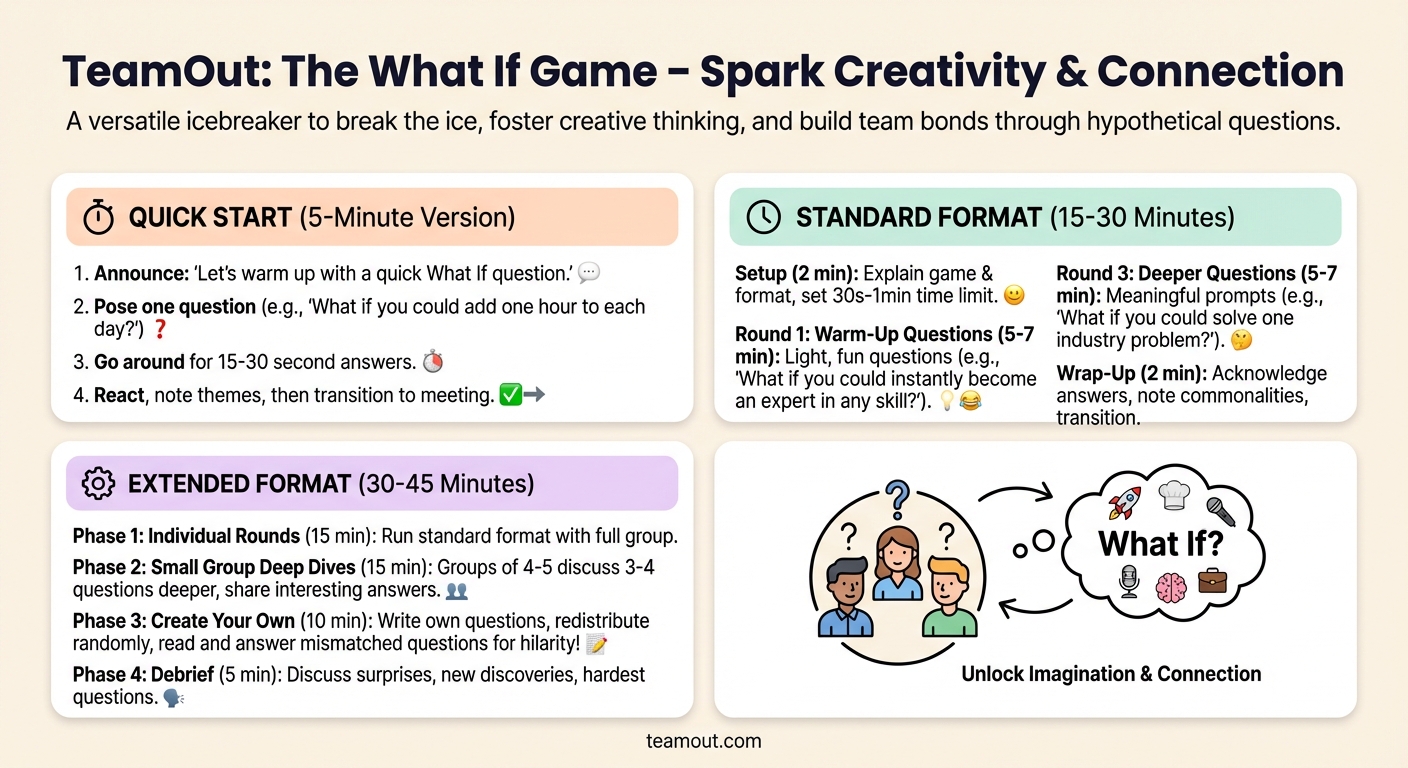
**QUICK START (5-Minute Version)**
For a fast icebreaker before meetings:
1. Announce: "Before we dive in, let's warm up with a quick What If question."
2. Pose one question to the group (e.g., "What if you could add one hour to each day — how would you spend it?")
3. Go around the room (or unmute volunteers) for quick 15-30 second answers
4. React to interesting answers, note common themes, then transition to your meeting
**STANDARD FORMAT (15-30 Minutes)**
**Setup (2 minutes)**
1. Explain the game: "I'll ask hypothetical 'What If' questions, and everyone shares their answers. There are no right or wrong answers — the more creative, the better!"
2. Establish format: Will everyone answer each question, or will you call on individuals?
3. Set expectations: Answers should be brief (30 seconds to 1 minute) to keep energy high
**Round 1: Warm-Up Questions (5-7 minutes)**
Start with light, fun questions to get people comfortable:
- "What if you could instantly become an expert in any skill?"
- "What if you had to eat only one cuisine for the rest of your life?"
- "What if you could swap jobs with anyone in this room for a day?"
**Round 2: Creative/Absurd Questions (5-7 minutes)**
Escalate to imaginative scenarios that spark laughter:
- "What if animals could talk — which species would be the most annoying?"
- "What if you had to survive a zombie apocalypse with only items from your desk?"
- "What if your life had a theme song that played every time you entered a room?"
**Round 3: Deeper Questions (5-7 minutes)**
If time and group vibe allow, introduce more meaningful prompts:
- "What if you could solve one problem in our industry overnight?"
- "What if you could give your 18-year-old self one piece of advice?"
- "What if you could guarantee one thing about your future?"
**Wrap-Up (2 minutes)**
- Acknowledge standout answers: "I loved when [Name] said..."
- Note any surprising commonalities discovered
- Transition smoothly to next activity or meeting content
**EXTENDED FORMAT (30-45 Minutes)**
For retreats, team building sessions, or social events:
**Phase 1: Individual Rounds (15 minutes)**
Run the standard format above with the full group.
**Phase 2: Small Group Deep Dives (15 minutes)**
1. Divide into groups of 4-5 people
2. Give each group 3-4 questions to discuss among themselves
3. Groups can go deeper, with follow-up questions and conversation
4. Optionally, each group shares their most interesting answer with the full room
**Phase 3: Create Your Own (10 minutes)**
1. Each person writes their own "What If" question on a slip of paper
2. Collect and redistribute randomly
3. Take turns reading the question you received and answering the one read by the person before you
4. Mismatched questions and answers create hilarious combinations!
**Phase 4: Debrief (5 minutes)**
- What surprised you about people's answers?
- Did you discover anything new about a teammate?
- Which question was hardest to answer?
Tips to implement the activity the right way
For Facilitators:
Question Selection:
- Start lighter, go deeper — build comfort before asking vulnerable questions
- Match questions to your audience (skip "What if you won the lottery?" for a CEO retreat)
- Have 2-3x more questions prepared than you think you'll need
- Mix categories: funny, thoughtful, work-related, completely random
- Avoid questions that could make anyone uncomfortable (politics, religion, personal finances)
**Pacing:**
- Keep it moving — don't let any one answer go longer than 90 seconds
- It's okay to skip to the next question if energy dips
- Read the room — if people are loving a topic, let the conversation flow; if it's flat, move on quickly
**Encouraging Participation:**
- Answer first yourself to model the level of creativity/vulnerability expected
- Celebrate creative answers: "I love that answer!" or "I never would have thought of that!"
- For shy participants, pair questions: "Sarah and Mike, you both answer this one"
- Never force someone to answer — always allow "pass" as an option
**Managing Group Dynamics:**
- If one person dominates, implement a "new voice" rule after each question
- For very large groups, use pair-share before full group: discuss with your neighbor, then share highlights
- Watch for inside jokes forming — this is a sign the activity is working!
**Common Pitfalls:**
- Questions that are too easy ("What if you could have any superpower?") — everyone's heard these
- Questions that are too complex — if it takes 30 seconds to explain, it's too complicated
- Going too deep too fast — don't ask about regrets before you've asked about pizza toppings
- Running too long — better to end while energy is high than drag until it fades
**Variations:**
**Competitive Version:**
After each round, vote on the most creative answer. Track points. Winner gets a small prize.
**Written Version:**
Everyone writes answers anonymously. Read them aloud and guess who wrote each one.
**Chain Reaction:**
One person asks a question, the next person answers AND asks a new question, creating a continuous chain.
**Category Rounds:**
Dedicate rounds to themes: "Work What Ifs," "Travel What Ifs," "Superpower What Ifs."
**Reverse What If:**
Start with an answer ("I'd learn to play piano") and others guess what the question was.
**Time Machine Edition:**
All questions relate to time: "What if you could relive one day?" "What if you could visit any era?"

